
Unresolved
On desire, dopamine, and the art of the almost

Here is a small tragedy I’m convinced we’ve all experienced…
You finally get the thing you wanted, and somewhere in the getting, the wanting dies. Quietly. No ceremony. Just gone. And you are left holding something real where something electric used to be and wondering why real feels so much smaller.
Desire, unresolved, is its own ecosystem.
It has a climate. A specific atmospheric pressure that you feel in the chest before you feel it anywhere else. It has a season that never quite turns. Permanent late afternoon. The light always doing something interesting. Nothing ever going dark, nothing ever breaking open into morning.
Scientists would call it a dopamine loop. Poets would call it longing. I call it the most inconvenient, exquisite, completely ungovernable thing the human body is capable of producing, and I have a complicated relationship with it.
The culture will tell you tension is the obstacle. The thing standing between you and the good part. Romantic comedies have built entire economies on this lie. Two hours of charged glances and almost-kisses and then the resolution, the kiss, the credits, the implication that everything good begins where the tension ends.
But the tension was the movie. Everything after is just epilogue dressed up as the plot.
And now we have dating apps. Which have done to desire what Amazon did to patience. Eliminated the wait entirely and called it progress. You can now acquire a person the same way you acquire a throw pillow. Browse, select, two-day delivery, mild disappointment upon arrival. We have optimized the entire process of human wanting and, in doing so, have quietly destroyed our tolerance for the slow build, the charged glance, the conversation that circles something for three hours without landing on it.
We have become resolution machines. Swiping toward the conclusion. Allergic to the almost.
And we wonder why nothing feels electric anymore. We killed the current. We were so busy closing loops we forgot that the open ones were the whole point.

I want to describe what it actually feels like because I think we’ve been dishonest about it.
It is not soft. It is not the gentle flutter of Victorian novels, women pressing hands to their chests and sighing at windows. It is physical, and it is inconvenient, and it takes up space that wasn’t offered to it.
You walk into a room, and your body knows before your brain does. Something recalibrates. Your awareness sharpens in one specific direction like a compass finding north, and from that point forward, you know exactly where that person is without looking. You track them the way you track a sound you can’t identify. The distance between you becomes a thing with texture. Every reduction of it registers. Every increase does too.
You are not relaxed. You are exquisitely, miserably, deliciously alert.
And underneath all of it, this heat that doesn’t peak. Doesn’t crest. Doesn’t release. Just hums at a frequency that makes everything else slightly less interesting by comparison.
Now put that person close enough to touch and don’t touch them.
That is where it gets genuinely dangerous.
The proximity without contact is its own specific torture. You are aware of the exact inches between your arm and his. You can feel the warmth coming off his skin without making contact with it. If he shifts slightly in your direction, something in your chest responds before your brain has processed that he moved. Your body is having an entire experience that your face is working very hard not to show. You are holding a conversation with your mouth while the rest of you is doing something completely different, and the effort of that split attention is exhausting and electric, and you would not stop it for anything.
That particular feeling, that specific unbearable awareness, is one of the most alive I have ever felt. More present than most things that actually happened.
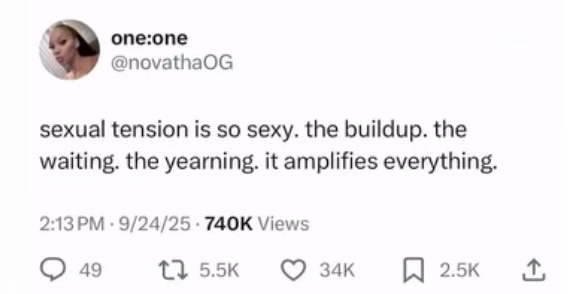
You know exactly what I’m talking about.
You’ve been in that room. You remember that person. You remember the specific quality of the air when they walked in, the way your attention reorganized itself without your permission, the conversation that meant two things the entire time, and you both let it. You remember going home afterward and lying in the dark and replaying moments that weren’t even moments technically, a look, a pause, the way he or she said something, and feeling more from that than from actual physical experiences you’ve had with other people.
You are not imagining it. You are not being dramatic. Your nervous system was responding to something real. The tension was real. The wanting was real.
The tragedy is what we’ve been taught to do with it.
The conversations that happen inside tension are their own specific art form, and I am a devoted admirer.
Nothing means only what it says. Everything is load-bearing. You are discussing something completely ordinary, restaurants, weather, a book, and the conversation is also entirely about something else, and you both know it, and neither of you will say so because saying so would end it, and ending it would be a small death.
The pauses are sentences. The eye contact is a question that the mouth hasn’t gotten around to asking yet. You choose certain words because of how they land, and you watch them land, and something moves across his face, and you file it away and keep talking about the restaurant.
I have had conversations like this that I remember more clearly than entire relationships.
Here is the satirical truth of it.
We have built entire industries around resolution. Around getting to the point. Around closing the loop, shooting the shot, sliding into the DM, manifesting the situationship into something with a label. We are a culture pathologically allergic to the unresolved. We want answers. Conclusions. The satisfaction of knowing where things stand.
And so we collapse the tension. We act on it. We send the text. We close the distance. We resolve it.
And then we wonder why it felt bigger before it became real.
Congratulations. You have successfully converted a masterpiece into a jpeg. Lower resolution. Easier to store. Completely shareable. Utterly lacking the thing that made it worth looking at.
Sometimes I think the imagination is the most erotic organ in the human body, and we treat it like a waiting room.
The person you want before you have them is a collaboration. Half of what you’re feeling is them. The other half is you, filling in the silence with everything you hope they are, building a version of them out of charged glances and the specific way they said your name and the things they almost said but didn’t. That constructed version lives at the exact intersection of who they actually are and who you need them to be.
No real person can compete with that. Reality has edges. Imagination doesn’t.
This is not a criticism of reality. It is simply an acknowledgment that desire is partly a creative act, and we are often more talented than we know.
There is a grief specific to resolution that I don’t think has a name yet.
Not the grief of something going wrong. The quieter grief of something going exactly as hoped and still losing the thing you loved most about it. The charge dissipating like weather after a storm. The hyperawareness dissolving. The person becoming regular, becoming known, becoming real in all the ways that make them ordinary.
You weren’t in love with them. You were in love with the wanting of them. And now the wanting is over, and what you have instead is a person, which is wonderful, which is also somehow less than what you had before you had anything at all.

I have stopped trying to resolve everything.
Some tension is meant to live exactly where it is. Some connections are complete in the almost. Some people are meant to remain permanently in that doorway, forever mid-sentence, forever almost. And trying to move them forward is a kind of violence against the thing they actually are.
The most alive I have ever felt has been in the space between wanting and having. That narrow corridor of pure anticipation where the dopamine fires and fires and fires because the reward has not arrived, and so the brain does not stop expecting it.
I have learned, slowly, against my nature, to stand in that corridor without immediately looking for the exit.
To let the wanting be the thing.
To understand that some of the most profound experiences available to the human body are the ones that never quite arrive.
There is a man I never slept with.
This was a few years ago now. We talked for six hours one night, the kind of conversation that has its own gravity, that pulls everything else in the room toward it. I don’t remember every word. I remember the feeling of it. The way the air felt different somewhere in the second hour. The way he looked at me once, briefly, like he was deciding something. A navy shirt. The specific timber of his voice when he dropped it slightly, not for effect, just because the conversation had gotten quieter and more honest, and his voice followed it there.
At the end of the night, we stood at the door, and neither of us moved for a moment that lasted longer than moments are supposed to last. I could feel the decision happening in real time, in both of us, the weighing of it. And then the moment passed. We said goodnight. I walked to my car.
I thought about that doorway for months afterward. I still think about it sometimes, the way you occasionally think about a place you visited once and loved and never went back to. Not with longing exactly. More like recognition. Like the memory is trying to tell me something it hasn’t finished saying yet.
Nothing happened. And somehow that is exactly why it stays.
Some things are more powerful for never becoming real.
Some fires burn longest when you never let them touch anything.
Some wanting is its own kind of having.
And some doorways are better left exactly as they were.
Still warm. Still unresolved. Still doing something that air is not supposed to do.
Until the next,
xoxo
emmy